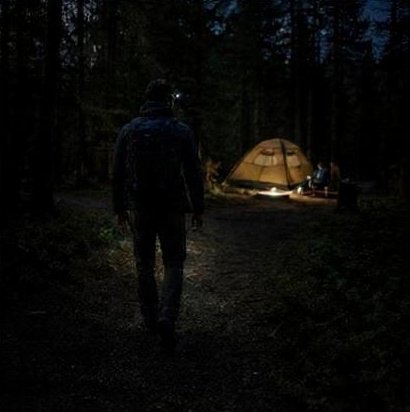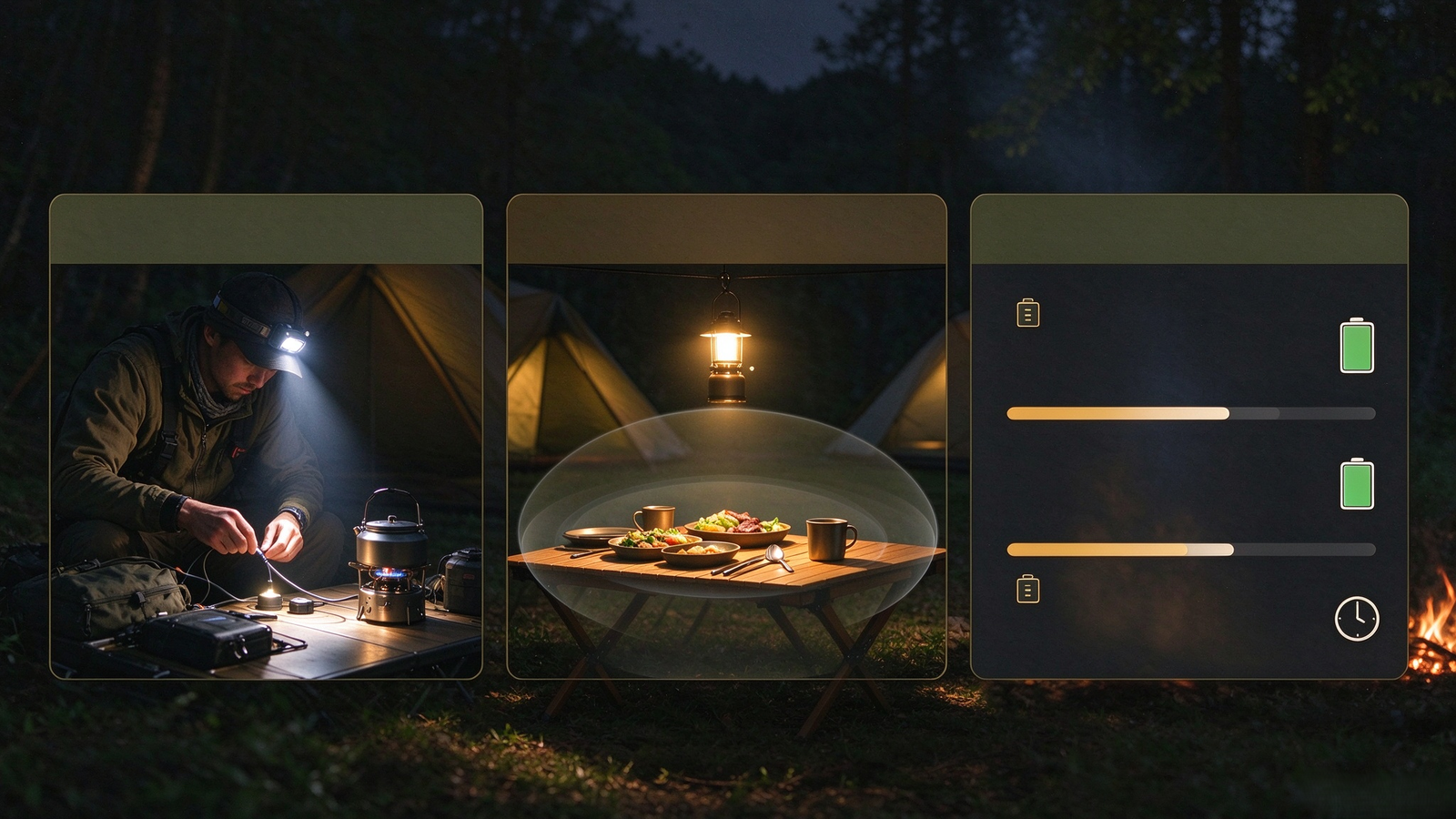
The sun goes down, dinner is still cooking, and suddenly the campsite feels a lot smaller. You can’t find the lighter, someone has dropped a tent peg, and the bag you need is somewhere under three other bags.
This is when camping lights stop feeling like optional gear.
But which one do you actually need: a headlamp, a lantern, or a regular flashlight?
The short answer is that they do different jobs. A headlamp helps you move and work with both hands free. A lantern lights up the space where everyone sits, cooks, and eats. A flashlight gives you a more focused beam when you need to see farther away.
You don’t necessarily need three expensive lights. You just need to choose the right setup for the way you camp.
In this guide, I’ll break down what each type does best, where it falls short, and how to put together a practical camping lighting kit without spending money on gear you rarely use.
Quick Picks: Which Camping Light Should You Buy First?
- Best first purchase: Headlamp. It’s useful for setting up camp, cooking, finding your way to the restroom, and dealing with small problems after dark.
- Best for car camping: LED lantern. It makes a picnic table, tent, or cooking area more comfortable for everyone.
- Best backup: Handheld flashlight. Keep one available for checking distant objects, searching around camp, or dealing with a dead headlamp.
- Best budget setup: One headlamp per person plus one shared lantern. This covers most ordinary camping situations without filling your gear box with lights.
1. Headlamp: The Light You’ll Probably Use Most
If I were helping a beginner choose just one camping light, I’d start with a headlamp.
The reason is simple: it follows where you look, and it leaves both hands free.
Imagine arriving at a campsite just before sunset. You still need to unpack the tent, connect the poles, find the stakes, and secure the rainfly. Holding a flashlight while doing all that becomes annoying surprisingly quickly. Put on a headlamp, and the light stays close to the work.
The same goes for cooking, sorting through a backpack, fixing a zipper, or finding something that has slipped underneath the car seat.
What a headlamp does well
- Keeps both hands free for camp chores.
- Makes walking around after dark easier.
- Packs small and works well for hiking and backpacking.
- Lets you use a lower brightness setting for close-up tasks.
- Gives each camper their own personal light source.
Where it falls short
A headlamp isn’t always the nicest light for a group.
When you turn toward someone while talking, your beam turns toward their face, too. A powerful headlamp can be uncomfortable across a dinner table. It also doesn’t light up an entire cooking or seating area evenly.
There’s another thing worth checking: the lowest brightness setting. Maximum output looks impressive on the packaging, but you’ll often want a softer beam when looking inside a tent or packing your sleeping gear.
What to look for when buying one
For general camping, prioritize a comfortable headband, simple controls, a useful low mode, and dependable battery life. A red-light mode can also be useful when you want less harsh light at night.
Don’t choose based on advertised lumens alone. A headlamp with a huge maximum output isn’t automatically the best option for ordinary campsite tasks.
My recommendation: Buy a headlamp first if you camp alone, hike, arrive after dark, or want one light that is useful for many different jobs.
Browse camping headlamps on Amazon
2. Camping Lantern: The Light That Makes Camp Feel Comfortable
A lantern solves a different problem. Instead of pointing a beam in one direction, it spreads light across a shared area.
This becomes especially useful when you’re car camping, preparing dinner at a table, playing cards, or organizing gear with other people.
Without a lantern, everyone might end up using a headlamp. That works, but the light keeps moving whenever someone turns their head. One person is looking for a fork, another is talking, and someone else is accidentally shining a beam into everyone’s eyes.
A lantern provides a steady source of light, so the whole group can see the same space.
What a camping lantern does well
- Lights a picnic table or camp kitchen.
- Makes it easier for several people to eat and talk together.
- Provides comfortable general lighting inside a tent when used appropriately.
- Can hang from a suitable hook or sit on a stable surface.
- Reduces the need for everyone to use a bright headlamp around camp.
What I’d watch out for
The biggest mistake is assuming brighter is always better.
A very bright lantern on a picnic table can create glare, wash out nearby surroundings, and disturb people at neighboring campsites. Inside a tent, excessive brightness can feel harsh because the fabric reflects light back at you.
Adjustable brightness matters more than a huge headline number. For dinner, you may want a medium setting. For finding something in a storage box, turn it up briefly. When winding down for the night, use the lowest comfortable setting.
Battery life also deserves attention. Runtime figures are usually tied to a particular brightness mode, so don’t assume a lantern will run all night at its maximum output.
Hanging or standing?
Both can work.
A lantern placed on the table is convenient, but it may create awkward shadows across faces and food. Hanging it from a suitable overhead point can spread the light more evenly.
If you hang one inside a tent, use the tent’s intended attachment point and keep the light within the tent’s load limits. Don’t attach a heavy lantern to a delicate fabric loop that wasn’t designed to support it.
My recommendation: A lantern is the next purchase after your personal light, especially for family camping, car camping, and longer evenings at the campsite.
Browse LED camping lanterns on Amazon
3. Flashlight: Still Useful, Just Not for Everything
A handheld flashlight is easy to understand: point it where you need light.
It can be particularly useful when you want a more concentrated beam to inspect something farther away, look around the edge of your campsite, or find an object outside the area illuminated by your lantern.
It’s also a sensible backup. If a headlamp runs out of power, a separate flashlight gives you another light source rather than leaving you with nothing.
What a flashlight does well
- Directs a beam toward a specific object.
- Helps when checking a trail, campsite boundary, or distant item.
- Works as a backup if another light fails.
- Can be useful for quick searches around the car or storage area.
The downside
You have to hold it.
That sounds obvious, but it matters when you’re carrying water, opening a tent, or trying to fix something with both hands. A flashlight can do many of the same jobs as a headlamp, but it’s usually less convenient for hands-on tasks.
A narrow beam can also be less comfortable for lighting a table or tent. You may see one bright patch while everything around it remains dark.
What to look for
Check the grip, switch, battery type, charging method, and beam pattern. If you plan to carry it as emergency gear, reliability and easy access matter more than an impressive maximum brightness figure.
A flashlight is also worth keeping in a vehicle camping kit, where a little extra weight is less of a concern.
My recommendation: Add a flashlight if you camp in remote or very dark areas, frequently explore after dark, or want a separate backup light.
Browse camping flashlights on Amazon
4. Headlamp vs. Lantern vs. Flashlight: What’s the Difference?
| Feature | Headlamp | Camping Lantern | Flashlight |
|---|---|---|---|
| Best use | Walking and hands-on tasks | Shared campsite lighting | Focused light and backup |
| Hands-free | Yes | Yes, when placed or hung | No |
| Lights a whole table | Not ideal | Best choice | Not ideal |
| Useful on a trail | Very useful | Usually inconvenient | Useful, but occupies one hand |
| Packs easily | Usually | Depends on size | Usually |
| Best for beginners | First purchase | Second purchase | Useful extra |
The important thing is that these lights aren’t really competitors. Each one fills a gap that the others leave.
If you only buy a lantern, you’ll still need a personal light when you walk away from camp. If you only buy a headlamp, you may find group dinners less comfortable. And if you rely only on a flashlight, simple jobs can become awkward when you need both hands.
5. The Best Camping Lighting Setup for Different Trips
You don’t need the same setup for every trip. Start with where you’re going, how much gear you can carry, and how you expect to spend the evening.
Setup A: Beginner or weekend camper
Bring: One headlamp per person and one shared lantern.
This is a practical starting point for most short camping trips. Everyone has a personal light for walking and small jobs, while the lantern handles dinner and general campsite lighting.
If your budget is tight, buy the headlamp first and add the lantern when you can.
Setup B: Car camping with family or friends
Bring: Headlamps, a rechargeable lantern, and a backup flashlight.
Car camping gives you more room, so a slightly larger lantern can be worth carrying. Place it near the cooking or seating area, then use headlamps when people need to move around.
Keep the backup flashlight somewhere easy to reach rather than buried in the trunk.
Setup C: Backpacking or minimalist camping
Bring: A lightweight headlamp and a small backup light or a reliable backup power plan.
Weight matters more when you carry everything on your back. A full-size lantern may be unnecessary if you mostly hike, cook a simple meal, and go to sleep early.
A compact headlamp with useful low and medium settings can handle most of the work. If you bring a separate backup, make sure it has enough power for the trip.
Setup D: Remote campsite or an overnight trip in poor weather
Bring: A dependable headlamp, a lantern if space allows, and an independent backup light.
The farther you are from a vehicle or other help, the more important it becomes to avoid relying on a single light source.
Check charge levels before leaving, pack spare batteries or a suitable power bank where appropriate, and keep at least one backup light accessible in the dark.
No lighting setup replaces safe navigation or the need to check weather and trail conditions.
6. How Many Lumens Do You Actually Need?
Lumens measure the total visible light output from a light source. They are useful, but they don’t tell the whole story.
Beam shape, distance, glare, brightness settings, and battery performance all affect how useful a light feels outdoors.
Here’s a simple way to approach it:
- Inside a tent: Look for a low, comfortable setting rather than maximum output.
- Cooking or eating: Choose a lantern that provides even light and can be dimmed.
- Walking around camp: A headlamp with a useful medium setting is often enough.
- Walking on a dark trail: Prioritize a clear beam, practical visibility, and dependable runtime.
- Checking something farther away: A flashlight with a more focused beam may be helpful.
Treat the highest lumen figure as a maximum, not as the setting you’ll use all evening. The best light is the one that gives you enough visibility without wasting battery or shining into everyone’s eyes.
7. Rechargeable or Battery-Powered?
There isn’t one perfect answer.
Rechargeable lights
These are convenient if you can charge your equipment before a trip and have a power bank available for longer stays. They can reduce the need to carry disposable batteries.
The trade-off is that you need to manage charging. A rechargeable light with a nearly empty battery isn’t much help, and charging options may be limited on a multi-day trip.
Replaceable-battery lights
These can be practical when you’re camping far from power. Spare batteries are easy to carry, and you can replace them instead of waiting for a light to recharge.
However, you need to bring the correct battery type and store spares properly.
My practical rule
For a short car-camping weekend, rechargeable lights are convenient. For longer trips away from power, think about total runtime, charging access, and whether carrying spare batteries makes more sense.
Whichever system you choose, check it before leaving home. Don’t wait until the campsite is dark to discover that your headlamp has been sitting in a drawer with a dead battery for six months.
8. Five Camping Lighting Mistakes Worth Avoiding
Mistake 1: Buying the brightest light available
More output doesn’t automatically mean better campsite lighting. Very bright lights can cause glare, consume power quickly, and annoy nearby campers.
Mistake 2: Bringing only a lantern
A lantern is great for the campsite, but inconvenient when you leave to find the restroom or collect something from the car. Bring a personal light, too.
Mistake 3: Forgetting a backup
Batteries run down, charging cables get left behind, and equipment can fail. A small backup light can make a big difference when your main light stops working.
Mistake 4: Ignoring low-light settings
Low mode is useful for reading, moving around inside a tent, and getting ready for bed. It can also help conserve battery power.
Mistake 5: Leaving lights on all night
Unless you need continuous lighting for a specific reason, switch off unnecessary lights before sleeping. This saves power, reduces light spill into neighboring campsites, and makes the night feel more natural.
9. A Simple Camping Lighting Checklist
Before you leave, run through this list:
- Headlamp for each person who needs a personal light.
- Shared lantern for the table or cooking area.
- Flashlight or another independent backup light.
- Fully charged batteries or the correct spare batteries.
- Charging cable or power bank, if needed.
- A suitable place to hang or position the lantern.
- A low-light setting for inside the tent.
- Easy access to the main light after dark.
You don’t have to buy everything at once. Start with the essentials for your type of trip and add equipment when you know what’s missing.
Final Verdict: Which Camping Light Is Best?
If you’re buying your first camping light, start with a headlamp. It’s compact, hands-free, and useful for everything from setting up a tent to walking around after dark.
Add a lantern when you want a comfortable shared space for cooking, eating, and relaxing. Keep a flashlight as a useful extra if you want a focused beam or a separate backup.
For most campers, the best all-around setup is simple: one headlamp per person, one shared lantern, and a backup light when the trip calls for it.
You don’t need the most expensive gear or the biggest lumen number on the shelf. You need lighting that works when you’re tired, your hands are full, and the campsite is already dark.
That’s what makes a good camping lighting setup worth packing.
Frequently Asked Questions
Is a headlamp or lantern better for camping?
A headlamp is better for walking and hands-on tasks because it leaves your hands free. A lantern is better for lighting a shared space such as a picnic table or tent. Most campers benefit from having both.
Can I use a flashlight instead of a headlamp?
Yes, but a flashlight occupies one hand. It can work for short walks or occasional use, but a headlamp is usually more convenient for cooking, setting up a tent, and handling equipment after dark.
What is the best camping lighting setup for beginners?
Start with a headlamp for each person and one shared LED lantern. Add a flashlight or another independent backup if you camp in remote locations or stay out for multiple nights.
How many lumens do I need for a camping lantern?
There is no single ideal number. Choose a lantern with adjustable brightness so you can use a comfortable low setting inside a tent and increase the output when you need more light around the cooking or seating area.
Are rechargeable camping lights worth it?
They can be convenient for weekend trips, especially when you can charge everything at home. For longer trips away from power, consider battery life, access to charging, and whether spare batteries would be more practical.
Should I leave my camping lantern on overnight?
Usually, no. Switch it off when you no longer need it to conserve battery power and reduce light spill. Keep an accessible personal light nearby in case you need to get up during the night.
What should I do if my main camping light runs out of battery?
Use an independent backup light if you have one. For future trips, check all lights before leaving, carry appropriate spare batteries or charging equipment, and avoid relying on a single light source in remote locations.